

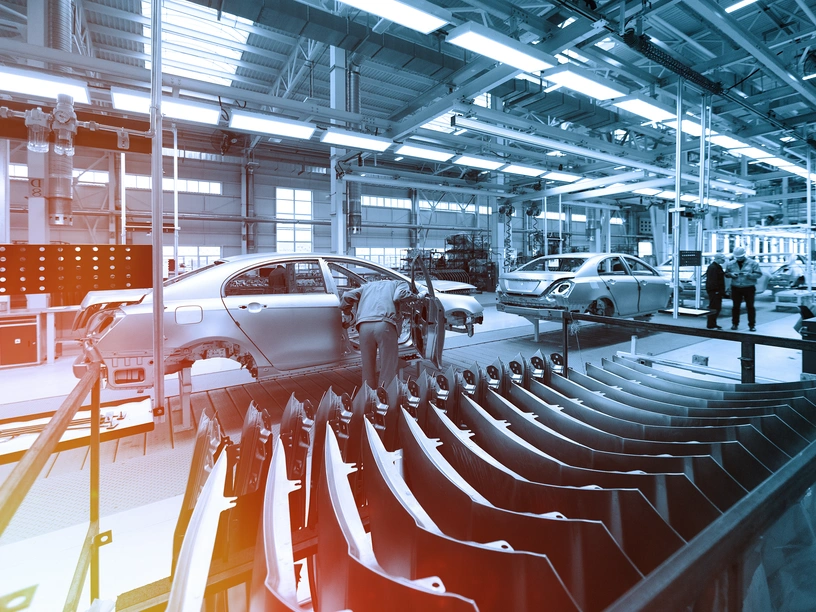
The automotive industry is still in a state of upheaval. In Germany, it is the largest industrial sector in terms of total turnover. Top politicians, including the Federal Chancellor, have repeatedly emphasized the sector's central role in Germany's prosperity and assured it of their support. Increasing internationalization and technological change have further intensified competition within the industry. Global competition and the associated pressure to innovate have never been more visible.
Electromobility intensifies the pressure on margins
In recent months, several German manufacturers have presented new all-electric mid-range SUVs with significantly improved technical features in terms of range and charging speed. The problem for all traditional manufacturers is that the new model generations of electric vehicles are also putting pressure on the margin mix. Models with combustion engines will remain significantly more profitable for the time being. Established manufacturers are therefore faced with a dilemma: on the one hand, high levels of investment are required to keep pace with Chinese competitors in the field of electromobility, while on the other, the resulting models are creating additional pressure on margins. However, they are on the right track, as they can no longer rely on their technological leadership in combustion engines. In China, the world's largest car sales market, electric vehicles already have a market share of almost 50%.
Investment wave subsides
The automotive industry is in the midst of an intensive investment cycle that is increasingly reaching its peak. After years of high spending on research, development and new platforms, investment volumes are now gradually beginning to decline. For many manufacturers, this phase marks the transition from high upfront costs to a stronger focus on efficiency and capital discipline. At the same time, it is clear that the transformation to electromobility remains complex and that adjustments to strategies and timetables are not uncommon in the industry.
Proximity to customers is becoming mandatory: "local-for-local" is the motto.
Global car sales have not yet returned to their pre-coronavirus pandemic highs. At regional level, the picture is varied. While sales volumes are declining in the key car markets of Europe and North America, growth is particularly evident in Asia (ex Japan) and South America. This development has an impact on the regional distribution of car production. This is also an expression of manufacturers' "local-for-local" strategies. They want to produce where the customers are. This is all the more important in view of the current trend towards more protectionist measures. However, in order to participate in volume growth in the long term, particularly in Asia, or at least maintain their current volumes, traditional manufacturers must also offer products that meet the needs of local customers. For example, karaoke functions are very popular in China. It is therefore not only important to produce locally, but also to develop and adapt products regionally. For example, a German manufacturer has announced that it is developing a new platform for the Chinese market together with a Chinese partner and has started a cooperation with a US company for the rest of the world. Other German manufacturers are also working with special partners in China for infotainment functions and driver assistance systems.
"Software Defined Vehicle": New architecture for the industry
A pioneer of the electric car has not only made electric mobility suitable for the masses, but has also introduced a completely new type of vehicle architecture to the industry. Traditionally, cars have hundreds of control units installed for various vehicle functions, which are provided by suppliers and are difficult to update at a later date. This company radically simplified the vehicle architecture by vertically integrating and replacing many ECUs with centralized computers running in-house software. This not only enabled cost savings in production, but also over-the-air (OTA) updates, as we know them from smartphones.
In the meantime, all manufacturers are striving for a transformation to "Software Defined Vehicles" (SDV). New generations of vehicles are also based on four functionally differentiated supercomputers. However, if you ask benchmarking service providers, you will learn that the established manufacturers still have a much longer way to go to SDV than companies that have been able to design new vehicles without taking existing systems and suppliers into account. The transformation to SDV is also increasing the speed of product cycles. In China, local manufacturers are already presenting new models or new vehicle functions every year, similar to smartphone manufacturers. Traditional OEMs are still working with multi-year product cycles.
Autonomous driving is challenging traditional business models
Currently, most car manufacturers are focusing on level 2++ assistance systems, where the driver still has to constantly monitor the vehicle. One international supplier even recently announced that it was halting its investment in level 3 (temporary avoidance of traffic). The development of fully autonomous driving systems (level 4) requires further significant investment, which traditional manufacturers will find difficult to afford alongside the transformation to electromobility. It therefore seems more likely that this technology will be established by large platforms, which will then sell it as a software subscription to vehicle manufacturers or even end customers. It is questionable what impact fully automated driving (Level 4) will have on car manufacturers' business models once it has become widespread. Then all occupants will just be passengers and will be able to engage in other activities. Driving itself will no longer be a differentiating factor, but rather the design and usability of the interior. In addition, interest in owning a vehicle could continue to decline.
China's carmakers focus on market presence instead of price wars
It is advantageous for Western OEMs that Chinese manufacturers have not yet penetrated the European market with aggressive pricing strategies. For example, a Chinese mid-range model is offered in Germany from around 47,000 euros. One reason for this is the EU's tariffs on imports from China. However, the Chinese OEMs have no interest in transferring the sometimes ruinous price war in their home market to Europe. Instead, they are also focusing on the "local-for-local" principle and are planning production capacities in Europe, for example in Hungary. Vehicles built in Europe naturally have higher production costs, which is likely to narrow the cost gap with domestic manufacturers. This gives Western manufacturers the opportunity to retain their customers in Europe, at least in part, through brand loyalty.
It can be assumed that Chinese manufacturers will gradually gain market share instead of abruptly overrunning the market. This was also the case after Japanese and Korean suppliers entered the European market. Nevertheless, this should not obscure the fact that the future of the industry will be decided in the Far East and not in the stagnating European car market.
The current year is characterized by uncertainties
Many of the currently announced model series will not be available until 2026. The hoped-for success of these models will therefore not be felt until the end of 2026 at the earliest. Until then, there are still many uncertainties. On the one hand, sales and price levels in China have recently been very weak, even if prices have now stabilized to a certain extent. This is due to the stricter regulation of bank commissions paid to car dealers for financing brokerage. However, the flip side of this stabilization is even weaker sales, which is why many Western OEMs are currently making support payments to dealers in China and streamlining their dealer networks there.
The issue of US tariffs also harbors many uncertainties. A retroactive implementation of the 15 percent deal has been announced, meaning that manufacturers no longer have to pay the most recent punitive tariffs totaling 27.5 percent. However, this is also 15% more than before Donald Trump's tariff policy. There is also the question of how resilient the agreements with Donald Trump will be in the long term.
Conclusion: A challenging market environment for Western OEMs
The market environment for Western OEMs remains challenging. In particular, the burden of US tariffs, developments in China and the respective investment cycles in electromobility set manufacturers apart from one another.
Legal information
Marketing ad - All information published here is for your information only and does not constitute investment advice or any other recommendation. The statements contained in this video reflect the current assessment of DJE Kapital AG. These may change at any time without prior notice. All statements made have been made with care in accordance with the state of knowledge at the time of preparation. However, no guarantee and no liability can be assumed for the accuracy and completeness. The video and its content are protected by copyright. Long-term experience and awards do not guarantee investment success. Securities are subject to market-related price fluctuations that may not be offset by the active management of the asset manager. Please note our risk warnings.