

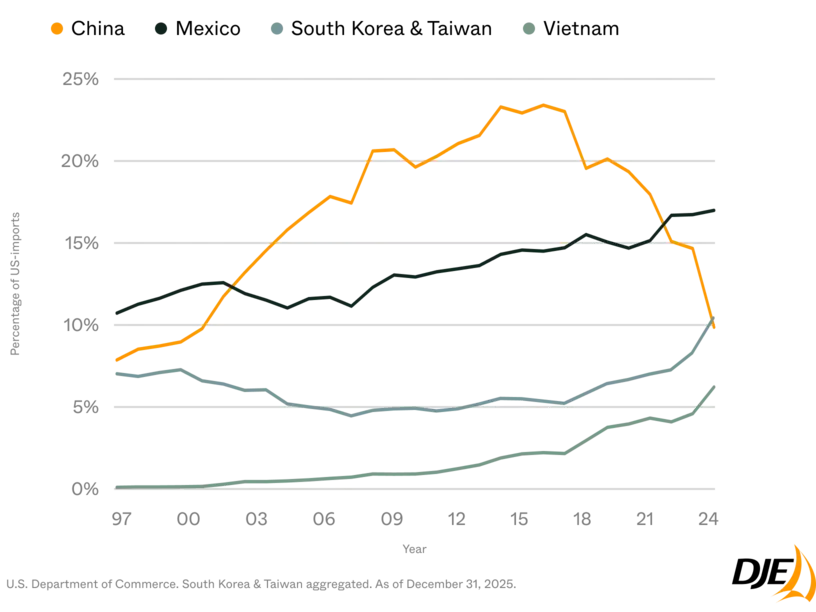
The weights within US foreign trade are shifting noticeably. China’s share of US imports has fallen from 21.6% in 2017 to 9.0% in 2025. At the same time, other supplier countries have gained ground. Mexico now accounts for 15.7%, while Vietnam has risen to 5.7%. Taiwan and South Korea together reach 9.6%, thereby overtaking China. As a result, the United States now sources a far smaller share of its goods directly from China than it did just a few years ago.
However, anyone interpreting this as a far-reaching decoupling is oversimplifying the picture. US goods imports continue to grow. Between 2017 and 2024, they increased in nominal terms by an average of 5.7% per year. In the four preceding years, annual growth had been just 0.8%. The declining share of China therefore primarily reflects a reorganisation of supply chains.
This shift is particularly evident in strategically important industries. Mexico and Vietnam have gained market share above all in automotive suppliers as well as in the electronics and semiconductor sectors. Mexico has also expanded its position in automobiles. Taiwan and South Korea are playing an increasingly important role in technology-intensive and semiconductor-related supply chains.
While China is disappearing from part of the direct US import statistics, the country remains present within supply chains. This should not be understood simply as circumvention. Rather, production stages, intermediate inputs and final assembly are being redistributed geographically.
As a result, economic dependence on China has declined less than the chart may suggest at first glance. Trade statistics show the country from which a good is imported into the United States. They do not, however, reveal where the intermediate goods originate or where the actual value creation takes place. According to the assessment of the US Federal Reserve, key new supplier countries have in fact recently deepened their own import linkages with China. This is reminiscent of the Trojan horse: what disappears from the direct import statistics remains present through upstream supply chains.
For investors, that is precisely the key message. Globalisation is not disappearing; rather, value chains are being reorganised. Mexico benefits from its proximity to the US market, Vietnam from production relocations, and Taiwan and South Korea from their strong position in technology-intensive supply chains. Less China in the customs register therefore does not automatically mean less China in the supply chain.
Legal Notices
Marketing Advertisement – All information published here is provided solely for your information and does not constitute investment advice or any other recommendation. The statements contained in this document reflect the current assessment of DJE Kapital AG. These may change at any time without prior notice. All information provided has been prepared with due care based on the knowledge available at the time of preparation. However, no guarantee or liability can be assumed for its accuracy or completeness.