

For a long time, high government debt was considered a problem for the future. Now, the consequences are becoming apparent. The yield on 10-year U.S. Treasury bonds stands at around 5.2 percent (as of the end of September 2026), its highest level since 2007. The yield on 30-year U.S. Treasury bonds, at just under 5.5 percent, is also at a level last seen in 2004. Higher interest rates significantly increase the cost of government refinancing and put pressure on valuations in the stock and real estate markets.
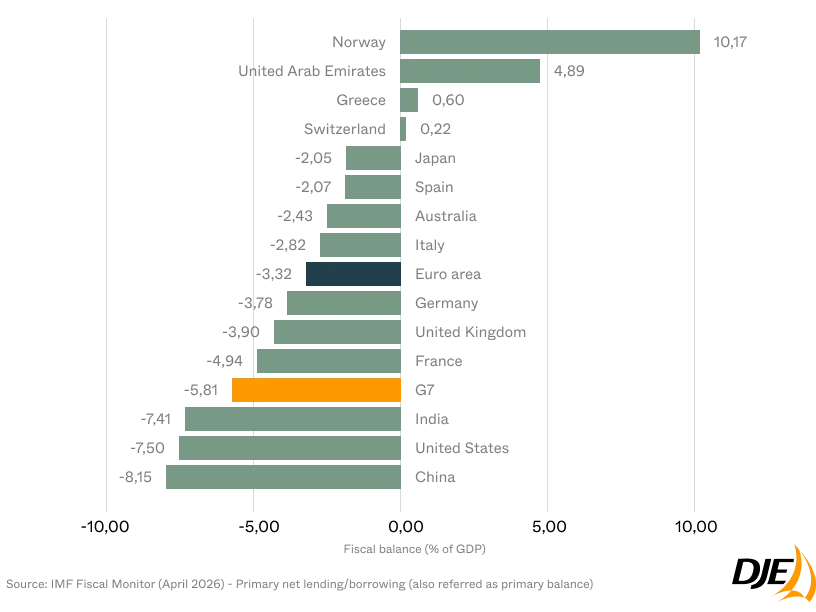
A look at the fiscal situation explains part of this nervousness. For 2026, the U.S. is expected to have a federal deficit of 7.5 percent of gross domestic product. China’s deficit is even higher, at 8.2 percent. On average, the G7 countries have a deficit of 5.8 percent, while the eurozone’s stands at 3.3 percent. Overall, however, the major economies continue to finance themselves to a considerable extent through borrowing.
These deficits are not a short-term blip. According to projections by the Congressional Budget Office (CBO), U.S. federal debt held by the public is set to rise to 101 percent of GDP by 2026. By 2030, it is expected to reach 108 percent, surpassing the previous postwar record of 106 percent set in 1946. For 2036, the CBO forecasts 120 percent of GDP. Net interest payments alone are projected to reach 3.3 percent of GDP as early as 2026 and rise to 4.6 percent by 2036.
At the same time, the chart shows that high government revenues and sound budgets are certainly possible if certain conditions are met. Norway is expected to achieve a surplus of just over 10 percent of GDP in 2026, while the United Arab Emirates is projected to achieve a surplus of just under 5 percent. In both cases, revenue from oil and gas plays a central role. Greece is also expected to achieve a small surplus. This would be remarkable for a country that, during the European sovereign debt crisis, was still considered synonymous with fiscal instability.
Government debt is not inherently bad. Public deficits generally lead to surpluses in the private sector. Sensible fiscal stimulus can enable economic growth, promote innovation, and create jobs—at least in the short term.
Therefore, the level of debt alone is not the decisive factor. Investors are increasingly asking whether deficits are compatible with a credible growth path, sustainable interest costs, and a reliable fiscal policy. As long as this question remains unanswered, higher risk premiums on long-term government bonds will become the new normal.
Legal Notices
Marketing Advertisement – All information published here is provided solely for your information and does not constitute investment advice or any other recommendation. The statements contained in this document reflect the current assessment of DJE Kapital AG. These may change at any time without prior notice. All information provided has been prepared with due care based on the knowledge available at the time of preparation. However, no guarantee or liability can be assumed for its accuracy or completeness.