

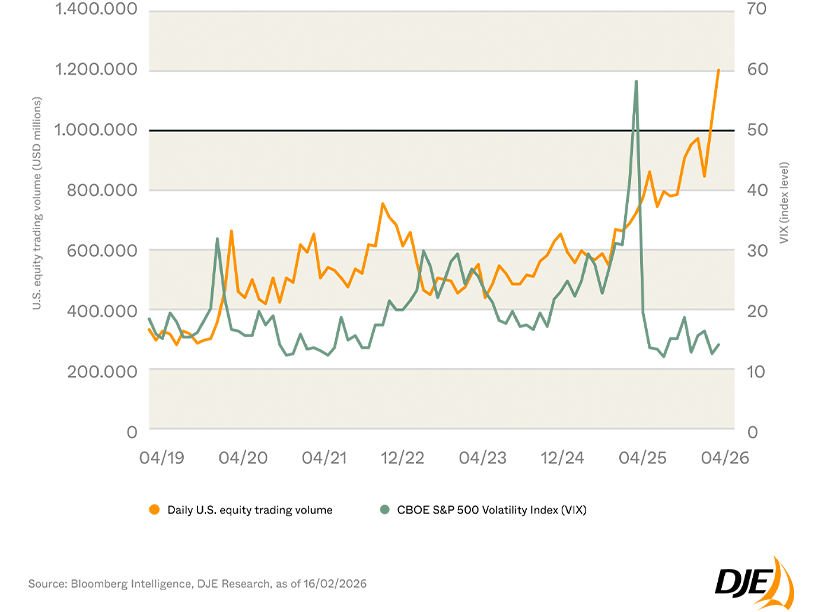
At the beginning of 2026, the average daily trading volume on the US stock markets exceeded the one trillion US dollar mark for the first time. It is striking that the so-called implied volatility at index level has remained comparatively low since "Liberation Day". Implied volatility measures the price fluctuations expected by the market for the coming weeks. It is often represented by the CBOE S&P 500 Volatility Index (VIX), which is therefore also considered a "fear barometer." A low VIX signals that investors expect only moderate fluctuations overall.
The higher volume is partly a result of the increased market capitalization of the US stock market, which is currently estimated at around USD 68 to 69 trillion. As a result, even moderate relative shifts between sectors or strategies lead to significantly higher nominal trading values.
However, the apparent calm in the index level masks significant movements within individual market segments. While the VIX signals low volatility in the overall market, individual sectors and stocks are showing widely divergent price trends in some cases. Growth-oriented software stocks have recently been under pressure, while more defensive sectors such as telecommunications, energy, and commodities have seen capital inflows and performed significantly better.
The increase in trading volume reflects a pronounced sector and country rotation, which accelerated in 2026. Institutional investors — including hedge funds, asset managers, and pension funds — are increasingly diversifying their positions and reducing concentration risks in US- and technology-focused portfolios.
Another driver of volume is the high level of activity among private investors. Retail investors are estimated to account for 20 to 25 percent of total trading volume, which is well above the long-term average.
The record level of trading volume is less a reflection of increased market risks than the result of structural changes: an overall larger market size, increasing diversification of institutional portfolios, and continued high participation by private investors. Low index volatility should therefore not be interpreted as a sign of inactivity or indifference, but rather reflects a broader, more selective market structure.
An environment characterized by high trading activity, pronounced sector rotation, and increasing divergence at the individual stock level creates a challenging but also promising market environment. In such phases, sound research, consistently selective stock selection, and flexible allocation decisions become increasingly important, as price developments between individual sectors and companies diverge much more strongly.
Legal information
Marketing advert: All information published here is for your information only and does not constitute investment advice or any other recommendation. The statements contained in this document reflect the current assessment of DJE Kapital AG. These may change at any time without prior notice. All statements made have been made with care in accordance with the state of knowledge at the time of preparation. However, no guarantee and no liability can be assumed for the accuracy and completeness of the information.