

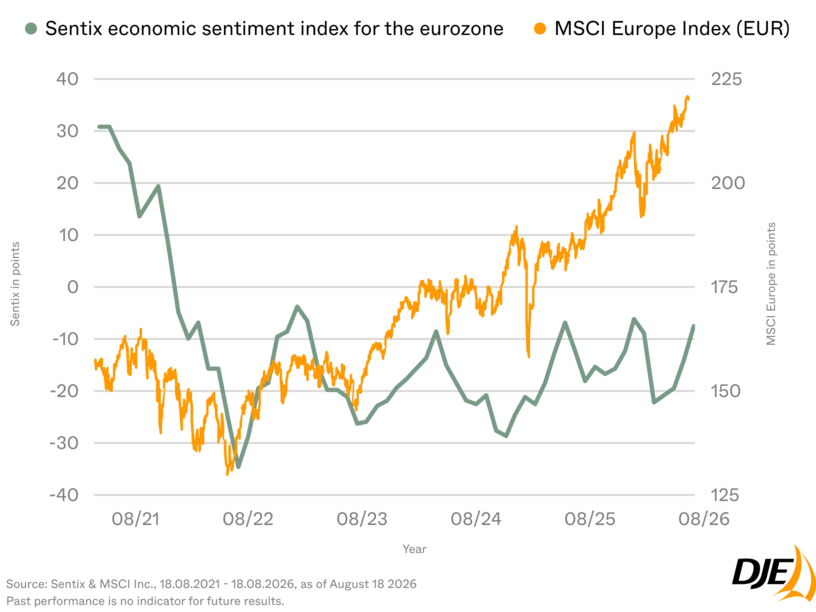
For some time now, public sentiment in Europe has been shaped by a sense of permanent crisis. Wars and geopolitical tensions, migration, high budget deficits, rising debt levels, wildfires, job cuts in the car industry and political upheaval in Germany dominate the headlines. So far, the European equity market has taken all this remarkably in its stride. The MSCI Europe Index has risen from around 150 to more than 220 points since August 2021 – a gain of almost 50 per cent.
Only at first glance does this appear contradictory. Across the board, Europe's companies are far from being in crisis mode. Current forecasts point to nearly 20 per cent earnings growth in Europe for 2026, with above-average profit margins of more than 10 per cent.
Added to this is a robust labour market. Unemployment in the eurozone now stands at just around 6.3 per cent, close to historic lows. At the same time, the picture varies considerably across the region. Spain, despite a marked improvement, still records unemployment of some 10 per cent, yet this is a world away from the crisis years. Germany stands at just under 4 per cent, Italy at around 5.5 per cent and France at a little over 8 per cent. There is therefore no sign of a broad-based collapse.
Notably, the sector composition is also working in the European market's favour at present. Energy stocks, which carry a higher weighting in Europe, have recently benefited from the higher oil price, currently above USD 90 per barrel. Banks, another sector heavyweight, are benefiting from an interest rate environment that supports net interest income, from decent levels of activity and from loan losses that have so far remained moderate. The car sector, by contrast, which so often takes centre stage, matters less to the broad index than its media presence would suggest. Redundancies and structural problems are real, but they do not explain the market as a whole.
In summary: the stock market mirrors neither the economic cycle nor sentiment precisely. Markets price in expectations, earnings and sector trends. Europe in particular has shown recently that staying invested can pay off even when the mood is poor.
Legal Notices
Marketing Advertisement – All information published here is provided solely for your information and does not constitute investment advice or any other recommendation. The statements contained in this document reflect the current assessment of DJE Kapital AG. These may change at any time without prior notice. All information provided has been prepared with due care based on the knowledge available at the time of preparation. However, no guarantee or liability can be assumed for its accuracy or completeness.