

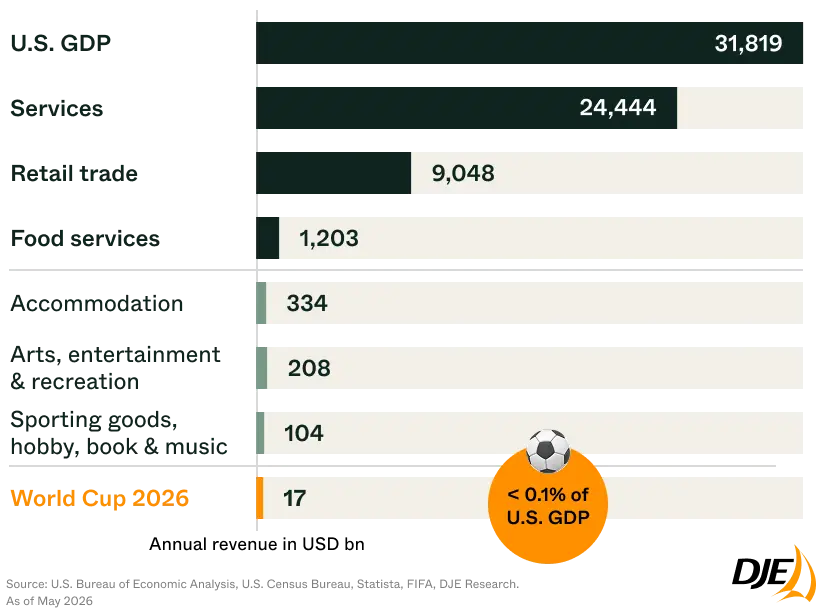
Major sporting events such as the Olympic Games or the World Cup are regularly associated with high expectations: more tourists, rising revenues, new jobs and positive economic stimulus. In the case of the United States, however, the economy is so vast that even an event on the scale of a World Cup barely registers at the macroeconomic level.
The chart illustrates these proportions. The expected economic impact of the 2026 World Cup is estimated at around USD 17 billion. That may sound impressive, but it amounts to less than 0.1% of US gross domestic product, which stands at roughly USD 32 trillion. For comparison, retail trade alone generates more than USD 9 trillion in annual sales. Private services account for around USD 24 trillion, including healthcare, financial services, business services and information technology. Even relatively small subsectors such as sporting goods retail are several times larger than the projected World Cup effect.
In addition, a large share of this spending does not represent new value creation, but merely consumption that is shifted in time or location. Someone booking a hotel room in Dallas or Miami during the World Cup may simply choose not to travel there at another time. This is why many studies on major sporting events conclude that the actual economy-wide effects are often significantly smaller than the figures projected in advance.
The picture can look different in emerging markets. There, major events are often accompanied by substantial investment in transport infrastructure, airports, telecommunications and public facilities. Such projects can generate long-term productivity gains and therefore produce a stronger economic multiplier. In the US, by contrast, the vast majority of the required infrastructure was already in place.
That said, the story may still add up for individual companies and sectors. Hotel operators, travel providers, ticketing platforms, restaurants and sporting goods manufacturers can all benefit from a temporary boost in demand. At the company level, the key question is therefore not the macroeconomic narrative, but which businesses are actually able to translate the event into additional revenues and profits.
The 2026 World Cup is therefore likely to be above all a global media event. For the US economy as a whole, however, it is closer to a rounding error than a meaningful economic stimulus package.
Marketing Advertisement – All information published here is provided solely for your information and does not constitute investment advice or any other recommendation. The statements contained in this document reflect the current assessment of DJE Kapital AG. These may change at any time without prior notice. All information provided has been prepared with due care based on the knowledge available at the time of preparation. However, no guarantee or liability can be assumed for its accuracy or completeness.