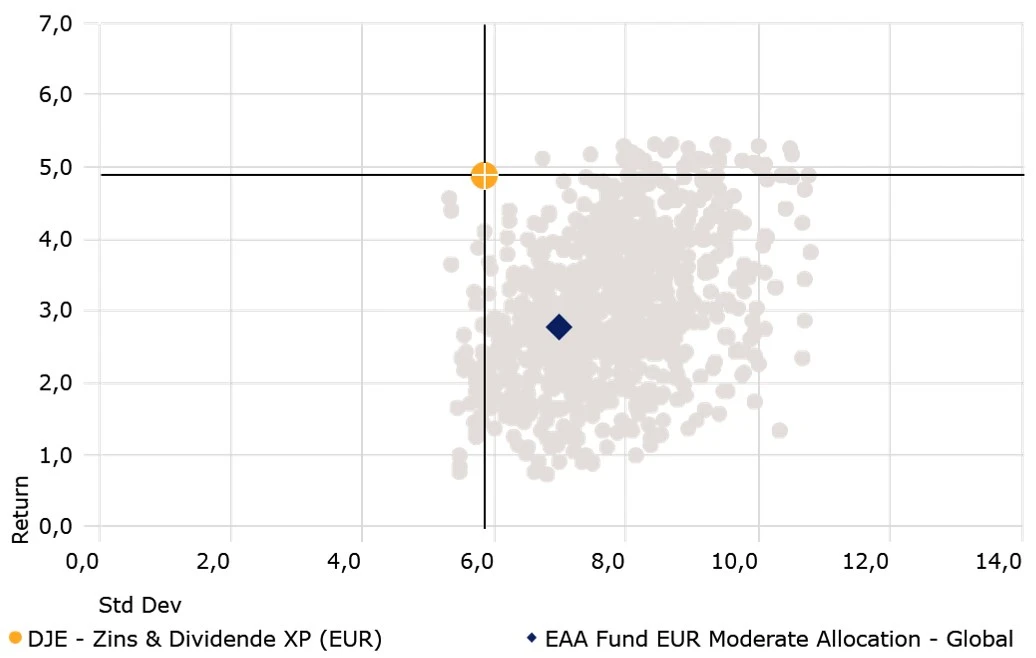


The original idea was to create an investment solution for risk-conscious investors by combining four sources of return: interest and dividends for recurring income, together with the potential for capital gains from equities and bonds. The first share class of DJE - Zins & Dividende was launched in December 2010. The fund is managed by its initiator, Dr Jan Ehrhardt, who was named Fund Manager of the Year 2025,* together with co-fund manager Stefan Breintner.
DJE - Zins & Dividende is celebrating its 15th anniversary. The XP share class (LU0553171439) of the balanced global multi-asset fund was launched in December 2010.** The fund invests at least 50% of its assets in bonds at all times, while its equity allocation may range from 25% to a maximum of 50%. This flexible allocation across asset classes is designed to generate recurring income from interest and dividends, as well as potential capital gains from equities and bonds, while keeping volatility as low as possible.
Within the bond portfolio, the focus is on high-quality sovereign and corporate bonds, most of which carry an investment-grade rating. On the equity side, the fund management team looks for regular dividend payments and shareholder-friendly corporate policies, such as share buybacks. Security selection targets an above-average dividend yield relative to the broader market, while selected growth stocks may complement the equity allocation.
Security selection and portfolio allocation combine top-down and bottom-up analysis within a systematic six-stage scoring process. Currency risks are hedged depending on market conditions. The portfolio is managed actively and independently of benchmark constraints.
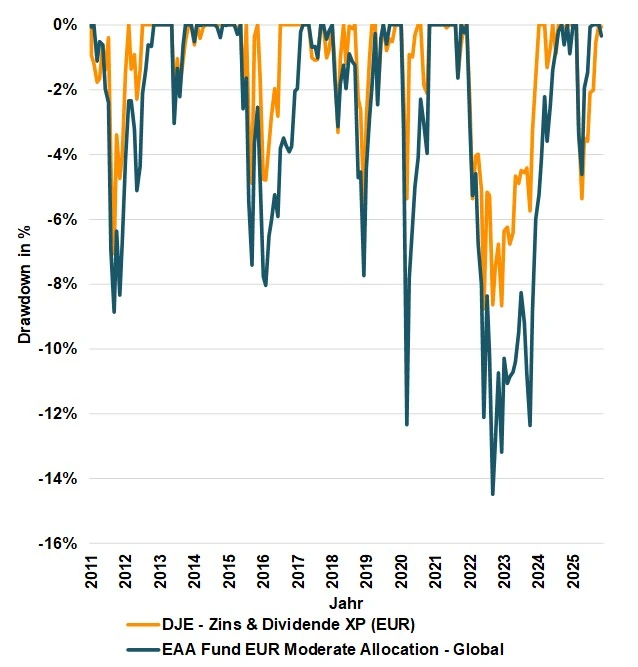
This investment approach has enabled the fund to navigate a wide range of market environments and major crises since its launch in December 2010. These include structurally challenging periods such as the eurozone sovereign debt crisis of 2011–2012, the downturn in China in 2015–2016 and the period of high, at times double-digit, inflation in 2022. More recent events include the COVID-19 pandemic from 2020 to 2022, the war in Ukraine from 2022 onwards and the so-called “Liberation Day” in April 2025, when the US imposed tariffs worldwide. Thanks to disciplined risk management, the fund generally recorded smaller losses than its peer group during such periods.