

By 2026, robotics will reach an inflection point that extends far beyond traditional mechanical engineering cycles. What is emerging is a convergence of artificial intelligence (AI), sensors, data, and physical actuation – marking AI’s entry into the physical economy (Morgan Stanley), after having primarily scaled the knowledge economy to date. As with electrification, the internet, or the smartphone, this represents a foundational technology capable of reshaping entire industries.
Accordingly, expectations are high. Morgan Stanley projects that global robotics revenues will increase from around USD 100 billion today to approximately USD 2.6 trillion by 2035 – a 25-fold increase – and further to roughly USD 25 trillion by 2050, representing another tenfold expansion from 2035 levels. This would correspond to around 20% of today’s global GDP of approximately USD 115 trillion, placing robotics on a scale comparable to the world’s largest economic regions such as the US, China, and the EU.
Humanoid Robots: From the Lab to Industrial Scale
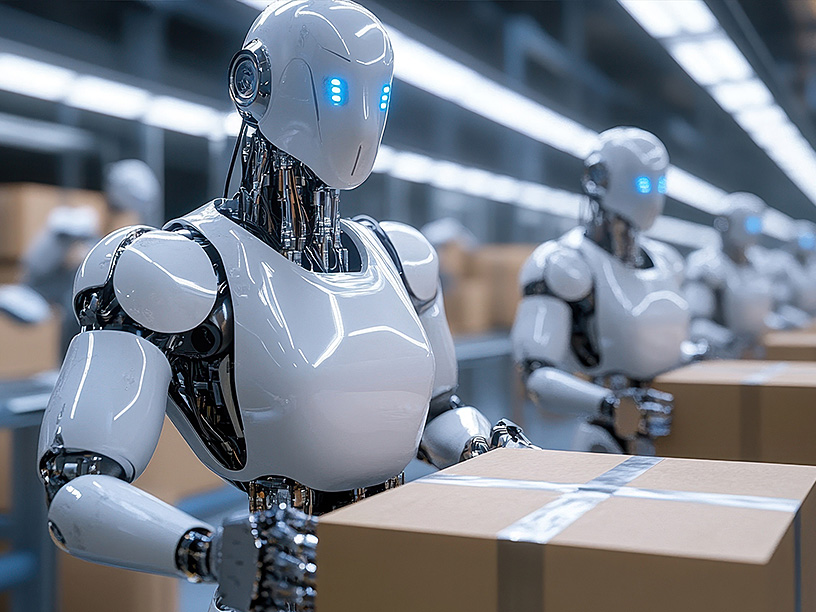
The transition is most visible in humanoid robotics. Only a few years ago, humanoid systems were largely prestige projects confined to academic laboratories. Today, dozens of companies are working on industrial-scale deployment. China stands out in particular, with more than 150 companies active in the field. The Chinese National Development and Reform Commission has already warned of a potential bubble. In March, China will finalise its new Five-Year Plan, in which Physical AI / Embodied Intelligence is designated as one of six strategic priority areas.
China’s advantage is structural: a strong electric vehicle and electronics industry, state-backed programmes, and a deeply integrated supply chain. Leadership is also evident in research activity. Over the past five years, nearly 8,000 humanoid-related patents have been filed in China, compared with around 1,500 in the US and 228 at the European Patent Office.
The result has been a wave of prototypes and early products from both Chinese and international providers. At CES 2026 in Las Vegas, 25 of the 38 robotics exhibitors showcasing humanoid demonstrations were from China (South Korea: 6, US: 4). With approximately 150,000 visitors, humanoid robotics was one of the event’s central themes. A supply-chain analysis by Morgan Stanley highlights the cost advantage: manufacturing with non-Chinese components (around USD 131,000 per unit) is roughly three times more expensive than production using a Chinese supply chain (around USD 46,000).
The use cases for humanoid systems follow a clear pattern: they are deployed in tasks that are dull, dangerous, or repetitive – particularly in logistics, factories, fulfilment centres, and on assembly lines. JP Morgan expects more than one billion humanoid units to be deployed by 2050, around half of them in household settings. Including all robot types – such as drones, autonomous vehicles, and industrial robots – estimates rise to as many as 6.5 billion units. Several manufacturers, including Boston Dynamics, have announced initial production runs in the high four- to five-digit range for 2026, with broader industry scaling likely to follow in 2027.
At the “brain” level of many systems, NVIDIA currently dominates with its Jetson and robotics-focused AI chips. However, the competitive landscape remains dynamic. At CES 2026, Boston Dynamics unveiled a new version of Atlas in partnership with Google DeepMind. In addition, the head of the humanoid programme at a major US provider recently moved to Boston Dynamics. Further updates are expected in early 2026. ARM has also reorganised into three divisions, one of which is explicitly focused on Physical AI.
Autonomous Vehicles: Data Platforms on Wheels
Autonomous vehicles currently represent the most mature form of Physical AI. Waymo (Alphabet) is expanding aggressively and operates fleets in multiple US cities. By 2026, the company plans to expand to around 20 cities, targeting approximately one million rides per week, including Phoenix, San Francisco, Los Angeles, and Atlanta. According to Morgan Stanley, the number of autonomously driven miles is expected to rise to nearly one billion per year by 2030. This growing data stream serves as a critical training foundation for other physical AI systems.
A major US competitor is pursuing a contrasting approach, relying exclusively on cameras and entirely dispensing with LiDAR. This strategy aims to reduce hardware costs and improve scalability for the mass-market robotaxi segment. Waymo, by contrast, prioritises sensor diversity, redundancy, and maximum safety. China again dominates in this area: with an estimated share of around 60% of globally delivered Level 2+ vehicles, the country is collecting a disproportionate amount of real-world driving data – a key input for autonomous systems.
At CES 2026, NVIDIA introduced a new platform for self-driving vehicles and continues to work with a German automotive manufacturer, a partnership that has been ongoing for eight years. A new Level 2+ model is scheduled for launch in the US, Asia, and Europe in 2026. In addition, NVIDIA offers Omniverse, a simulation environment in which systems can learn physical principles such as action and reaction and virtually train for rare events. This provides an alternative to accumulating billions of often repetitive real-world kilometres. In this context, NVIDIA can be compared to Android in the smartphone ecosystem – a technically robust platform alternative alongside the major proprietary players in autonomous driving.
Drones & Air Mobility: The Next Stage of Autonomy
Drones and low-altitude robotic systems are no longer a future concept but a rapidly expanding market. DJI of China (privately held) controls around 70% of the global drone market – a level of dominance rarely seen in other AI segments. The war in Ukraine has demonstrated how low-cost, modular, and remotely controlled systems can transform traditional military technologies and accelerate their development. In civilian applications, adoption is growing rapidly in agriculture – around one third of China’s arable land is already managed using drones – as well as in inspection, surveying, and logistics.
Start-ups such as Shield AI and Auterion are working on swarm autonomy, which is also relevant for autonomous transport systems and mobile robotics. In Germany, the Munich-based military drone start-up Helsing has gained particular prominence. In its most recent funding round in June 2025, the company was valued at approximately EUR 12 billion, placing it among the five most valuable tech start-ups in Europe.
Logistics & Warehouse Robotics: Where Robotics Is Already Profitable
In logistics, return on investment is already clearly visible. Amazon has reduced its human-to-robot ratio from 5:1 in 2017 to nearly 1:1 today. Around one million robots are currently deployed, alongside approximately 1.2 million employees in warehouses and logistics operations, making Amazon the global leader in absolute terms. By 2027, the company plans to build around 40 additional highly automated fulfilment centres (up from five today). By 2033, around 75% of warehouse operations are expected to be automated. Efficiency gains are estimated at approximately USD 10 billion per year. Walmart is also deploying robots extensively – for shelf monitoring, floor cleaning, and order picking for pickup services – and aims to automate around 65% of its stores by the end of 2026.
Brain-Computer Interfaces: The Human–Machine Interface
Brain-computer interfaces (BCIs) represent perhaps the most extreme manifestation of Physical AI from a human perspective: the direct interface between humans and AI. By the end of 2025, Neuralink had implanted chips in twelve test subjects and reports more than 15,000 hours of usage data. Potential applications range from medical treatments to cognitive enhancement and the remote control of robots. China is pursuing BCIs through a national roadmap (“NeuCyber”) extending to 2030, while Morgan Stanley estimates the US total addressable market for neurotechnology implants at around USD 400 billion by the middle of the next decade.
Big Tech: The Race for Physical AI Platforms
Companies such as Meta, Google, NVIDIA, and increasingly Apple and Amazon are investing heavily in robotics and Physical AI, significantly expanding their teams. OpenAI is also working on robotic systems. Robotics opens up new growth avenues and forces Big Tech to extend AI into the physical world in order to avoid being disrupted themselves. The necessary tools are currently being developed: vision-language-action models (such as DeepMind’s “Genie” or Meta’s “V-JEPA”), data from real-world interactions (including via Meta’s Ray-Ban devices), simulation environments (NVIDIA), and computing stacks designed to become standards for robot control. Those who control these platform layers are likely to gain influence over large parts of physical value chains – similar to Android and iOS, but this time for robots.
From an investment perspective, three layers can be distinguished. First, the developers and integrators of robotic systems. Second, platform providers for development, training, simulation, and operations, including AI models. Third, specialised component suppliers within a fragmented supply chain, such as sensor manufacturers, camera providers, chipmakers, and producers of actuators and motors.
Physical AI: A Platform Shift with Industrial-Scale Impact
Physical AI is emerging as the most comprehensive technological transformation driver in decades and is set to reshape the global economy. AI is evolving from a digital tool into an active agent in the real world – in factories, on roads, in the air, and ultimately within the human body. The strongest momentum is coming from humanoids, autonomous mobility, drones, logistics automation, and brain-computer interfaces. At the intersection of these domains, an ecosystem is forming with a potential market size of several tens of trillions of dollars – making Physical AI one of the most significant structural investment themes of our time.
Legal Notice
Marketing communication: All information provided herein is for informational purposes only and does not constitute investment advice or any other recommendation. The statements contained in this document reflect the current assessment of DJE Kapital AG and are subject to change at any time without prior notice. All information has been compiled with due care and to the best of knowledge at the time of preparation. However, no guarantee can be given as to its accuracy or completeness, and no liability can be assumed.